The AI Revolution: Transforming Global Commerce and the Future of Local Business
by James Naylor, Managing Partner
The AI Revolution: Transforming Global Commerce and the Future of Local Business
Artificial Intelligence (AI) is no longer a futuristic concept. It is a fundamental operating layer for modern commerce. Across industries, AI is moving from a niche experiment to an essential tool, redefining everything from supply chain logistics to personalised customer interactions. The impact is profound, resulting in unprecedented levels of efficiency, innovation and competitive pressure.
This moment marks the dawn of a new age industrial revolution, one driven not by steam or electricity, but by intelligent machines and data that are transforming how value is created and delivered across the globe.
The immediate changes businesses are seeing fall into three major categories: hyperautomation, deep data intelligence and enhanced customer experience. Companies that embrace these shifts are not just optimising; they are fundamentally changing their business models.
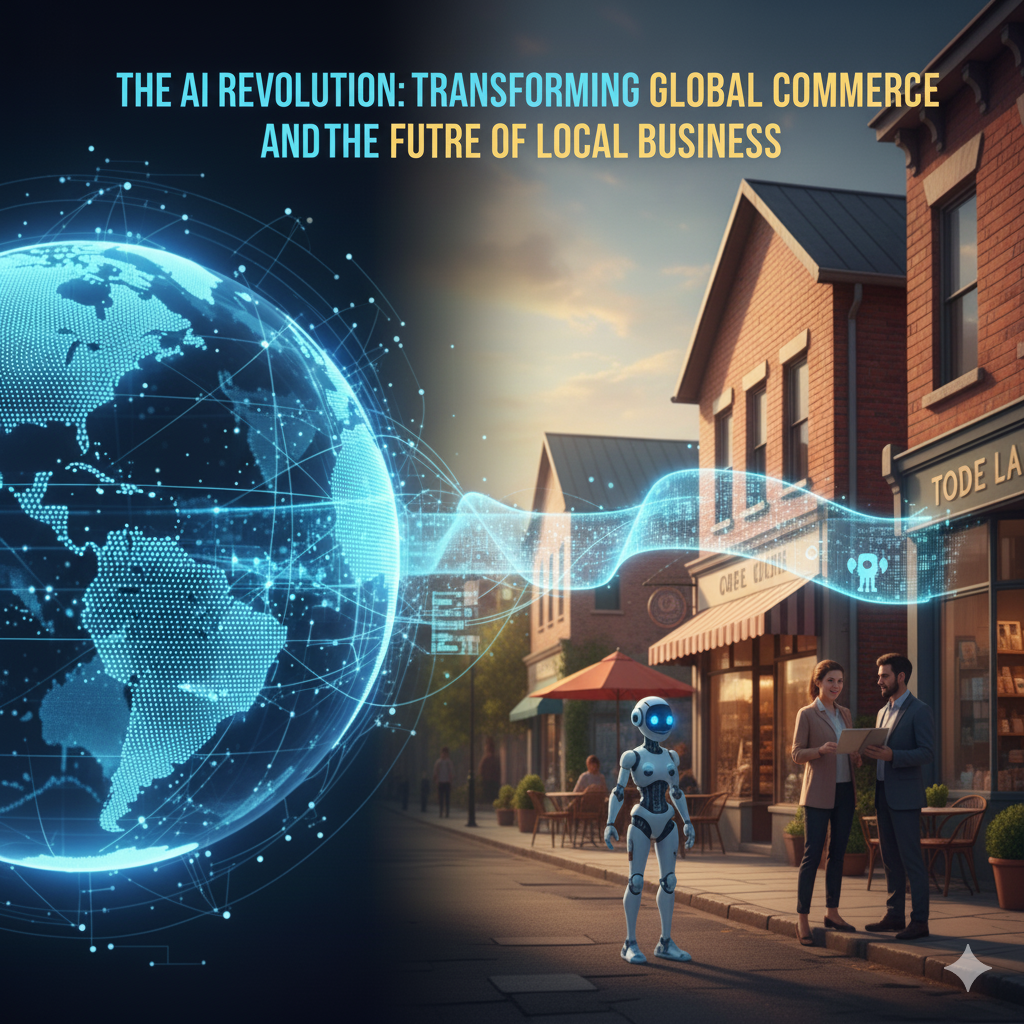
Global Impact: Efficiency and Innovation at Scale
For large, global businesses, AI acts as a turbocharger for existing operations.
1. Hyperautomation and Efficiency
AI powered tools are automating monotonous, repetitive and administrative tasks. This ranges from simple Robotic Process Automation (RPA) in finance and HR to complex, self optimising manufacturing lines. The goal is not just to cut costs but to redeploy human talent to higher value, creative and strategic roles that require emotional intelligence and complex decision making.
2. Deep Data Intelligence
AI’s true power lies in its ability to process massive datasets in real time, finding patterns that are invisible to humans. Businesses are using this for predictive analytics, forecasting demand with greater accuracy, identifying supply chain bottlenecks before they occur and personalising marketing messages at the individual customer level. This shift enables proactive, rather than reactive, strategy.
3. New Product and Service Creation
Generative AI models are accelerating R and D cycles. In pharmaceuticals, AI finds new drug targets; in design, it rapidly prototypes thousands of product variations. AI is becoming a co creator, leading to products and services that were previously impossible or prohibitively expensive to develop.
The Local Business Playbook in the Age of AI
The misconception that AI is only for tech giants is rapidly fading. The current wave of AI tools is characterised by accessibility, low cost and ease of integration, levelling the playing field for small and local enterprises. For the main street shop, the independent consultant or the neighbourhood service provider, AI is the key to maintaining a competitive edge against large chains.
1. Affordable and Automated Marketing
Local businesses can now leverage AI to compete on par with major corporations in digital marketing.
- Personalised Content AI tools can generate targeted ad copy, social media captions and blog posts tailored to local demographics in minutes.
- Smart Ad Spend Optimisation algorithms automatically adjust bids and targeting in real time to ensure every advertising pound is spent on the most likely converting customers within a specific radius.
2. 24 7 Customer Engagement
A small team cannot afford to staff a phone line 24 hours a day but an AI chatbot can. Implementing a simple, no code AI customer service agent on a website or social media channel can handle common queries such as store hours, menu items or booking appointments, freeing up staff to focus on in person service. This translates directly to improved customer satisfaction and retention.
3. Operations and Inventory Optimisation
AI tools for local businesses are focused on simple forecasting. A local cafe can use AI powered point of sale (POS) systems to predict peak hours and optimise staffing schedules or a boutique can use sales data to predict which apparel sizes and styles to order, reducing waste and overstocking. This optimisation is about running a leaner, more profitable operation.
4. The Human Touch Amplifier
Crucially, for local businesses, AI should enhance the personal service, not replace it. By offloading routine tasks, local owners and staff are freed up to engage in more meaningful, high touch interactions, the very thing that gives a local business its unique advantage.
Preparing for the Future
For the local business owner, the key to navigating the age of AI is starting small and being pragmatic.
- Identify the Pain Point Do not overhaul your entire system. Start by identifying the single most time consuming task whether it is replying to emails, drafting social media posts or scheduling appointments.
- Pilot a Low Cost Tool Implement an AI tool specifically designed for that problem, for example a simple chatbot, an AI writing assistant or a calendar scheduler.
- Train for Adaptation Encourage your team to experiment and view AI not as a threat but as a powerful assistant.
The AI revolution is here and it is democratic. The winners will be the businesses, local and global, that adapt quickly, focus on augmenting human creativity with machine efficiency and continually explore how these powerful tools can best serve their customers.

How Your Business Can Get Ready for This Change
Preparing your business for the AI revolution requires a clear plan and a willingness to embrace new ways of working. Here are some practical steps to get started:
-
Assess Your Current Processes Take stock of your existing workflows and identify areas where AI could add value. This might be automating repetitive tasks, improving customer engagement or gaining deeper insights from your data.
-
Invest in Education and Training Ensure that you and your team understand what AI can and cannot do. Training helps reduce resistance to change and encourages creative thinking on how to use AI effectively.
-
Start Small and Scale Gradually Pilot simple AI tools that address specific needs before committing to larger, more complex systems. This approach helps you learn quickly and avoid costly mistakes.
-
Partner with Trusted Providers Work with reputable AI vendors or consultants who understand your industry and can guide you through the technology adoption process.
-
Stay Customer Focused Always keep the customer experience front and centre. Use AI to enhance service quality, responsiveness and personalisation.
-
Monitor and Adapt Continuously AI technologies evolve rapidly. Regularly review your AI applications and be ready to adapt your strategies to take advantage of new capabilities and address emerging challenges.
By taking these steps, your business will be better positioned to thrive in this new age industrial revolution and seize the opportunities AI offers.